How Rideshare Trips Change by Hour Around NYC Nightlife Zones
Author
Hariprasad Reddy Kotakondla
Published
December 18, 2025
Executive Summary
This analysis examines 684 million rideshare trips across 36 months (January 2022–December 2024) to understand how nightlife zones reshape NYC’s transportation patterns. By linking NYC TLC trip data with 2,058 Yelp-identified nightlife venues, I reveal that nightlife zones—representing only 26.6% of taxi zones—capture 51% of all trips and 53.9% of total revenue. During nighttime hours (8 PM–4 AM), this concentration intensifies to 61.1% of citywide revenue. The surge index peaks at 2 AM, when nightlife zones capture 24% more trips than their daily average, demonstrating that nightlife fundamentally reshapes when and where the city moves.
Statistical rigor: Bootstrap confidence intervals quantify uncertainty around key findings, permutation tests confirm significant differences between zone types (p < 0.001), sensitivity analysis demonstrates robustness across venue threshold choices, and a random forest predictive model validates the explanatory power of nightlife zone classification.
Introduction
Project Context
This individual report is part of the Nightlife Analytics: The Economics of Cities After Dark group project for STA 9750. Our team examines how nightlife activity impacts New York City across multiple dimensions. The full group summary report is available at: Group Project Report.
Overarching Question (OQ):How does nightlife activity—bars, entertainment, and rideshares—drive NYC economies and affect city safety and life quality?
My Specific Question (SQ):How do rideshare trip volumes change by hour in nightlife zones compared to the rest of NYC?
This analysis directly supports the OQ by quantifying the temporal dynamics of nightlife-driven transportation demand. Understanding when and where nightlife generates rideshare activity reveals the economic footprint of after-dark entertainment and informs transportation planning, driver positioning strategies, and urban policy decisions.
Key Innovation
Unlike traditional analyses that simply compare daytime versus nighttime patterns, this study introduces a surge index that quantifies relative nightlife dominance across each hour of the day. By measuring how much nightlife zones exceed their average trip share at different times, the surge index reveals the precise hours when nightlife districts become transportation hotspots—providing actionable insights for drivers, planners, and policymakers.
Why This Matters
Nightlife districts are economic engines generating jobs, tax revenue, and urban vitality. Understanding the relationship between nightlife density and rideshare patterns is essential for:
Transportation Planning: Optimizing service allocation during peak nightlife hours
Economic Policy: Quantifying nightlife’s contribution to the transportation economy
Urban Planning: Informing infrastructure investments in entertainment districts
Methodology Overview
This analysis combines two primary data sources:
NYC TLC HVFHV Trip Records: High-volume for-hire vehicle (Uber/Lyft) trip data from January 2022 through December 2024, encompassing over 684 million individual trips.
Yelp Fusion API: Venue data for nightlife establishments (bars, lounges, dance clubs, music venues, cocktail bars) across NYC neighborhoods.
Nightlife Zone Definition: A taxi zone qualifies as a “nightlife zone” if it contains ≥5 nightlife venues. This threshold identifies zones with meaningful nightlife concentration while remaining robust to venue data incompleteness.
Nightlife Hours Definition: 8 PM to 4 AM, capturing the core window of evening entertainment activity.
Part 1: Data Acquisition
NYC TLC Trip Data
The NYC Taxi and Limousine Commission publishes monthly parquet files containing all high-volume for-hire vehicle trips. The following code downloads these files programmatically:
Show Code
# =============================================================================# TLC DATA DOWNLOAD# Programmatically download HVFHV parquet files from NYC TLC# =============================================================================# Create data directory structuredata_path <-"data/Nightlife_Rideshare_Analysis"dir.create(data_path, showWarnings =FALSE, recursive =TRUE)# Define date range for analysisyears <-2022:2024months <-sprintf("%02d", 1:12)# Base URL for TLC database_url <-"https://d37ci6vzurychx.cloudfront.net/trip-data"# Download each monthly filefor (year in years) {for (month in months) { file_name <-paste0("fhvhv_tripdata_", year, "-", month, ".parquet") file_url <-paste(base_url, file_name, sep ="/") dest_file <-file.path(data_path, file_name)# Only download if file doesn't existif (!file.exists(dest_file)) {message("Downloading: ", file_name)tryCatch({download.file(file_url, dest_file, mode ="wb", quiet =TRUE) }, error =function(e) {message("Failed to download: ", file_name) }) } }}message("TLC data download complete.")
Yelp API Venue Data
Nightlife venues were identified using the Yelp Fusion API. The following code queries the API across multiple NYC neighborhoods and nightlife categories:
Show Code
# =============================================================================# YELP API DATA COLLECTION# Fetch nightlife venue data from Yelp Fusion API# =============================================================================fetch_yelp_venues <-function(api_key) {if (api_key ==""||is.null(api_key)) {stop("Yelp API key not found. Set YELP_API_KEY environment variable.") } base_url <-"https://api.yelp.com/v3/businesses/search" all_venues <-tibble()# Target neighborhoods with known nightlife activity neighborhoods <-c("East Village, NY", "West Village, NY", "Lower East Side, NY","Williamsburg, Brooklyn", "Midtown Manhattan, NY", "Hell's Kitchen, NY","Astoria, Queens", "Park Slope, Brooklyn", "SoHo, NY", "Bushwick, Brooklyn" )# Nightlife-specific Yelp categories categories <-c("bars", "lounges", "danceclubs", "musicvenues", "cocktailbars")for (hood in neighborhoods) {for (cat in categories) {for (offset inseq(0, 50, by =50)) {tryCatch({ response <-GET( base_url,add_headers(Authorization =paste("Bearer", api_key)),query =list(location = hood,categories = cat,limit =50,offset = offset ),timeout(30) )if (status_code(response) !=200) break data <-content(response, as ="parsed")if (length(data$businesses) ==0) break venues <-tibble(id =map_chr(data$businesses, ~.x$id),name =map_chr(data$businesses, ~.x$name),latitude =map_dbl(data$businesses, ~.x$coordinates$latitude),longitude =map_dbl(data$businesses, ~.x$coordinates$longitude),rating =map_dbl(data$businesses, ~.x$rating),review_count =map_int(data$businesses, ~.x$review_count),categories =map_chr(data$businesses, ~paste(map_chr(.x$categories, ~.x$title), collapse =", ")) ) all_venues <-bind_rows(all_venues, venues)Sys.sleep(0.2) # Rate limiting }, error =function(e) {message("API error for ", hood, " - ", cat) }) } } }return(all_venues %>%distinct(id, .keep_all =TRUE))}# Fetch venues using API key from environment variableYELP_API_KEY <-Sys.getenv("YELP_API_KEY")nightlife_venues <-fetch_yelp_venues(YELP_API_KEY)# Cache results for reproducibilitywrite_csv(nightlife_venues, "nightlife_venues_cached.csv")
NYC Taxi Zone Boundaries
Taxi zone shapefiles are downloaded from NYC Open Data:
Show Code
# Download taxi zone shapefile from NYC Open Datataxi_zone_url <-"https://d37ci6vzurychx.cloudfront.net/misc/taxi_zones.zip"download.file(taxi_zone_url, "taxi_zones.zip", mode ="wb")unzip("taxi_zones.zip", exdir =".")
Part 2: Data Quality Assessment
Sampling Quality
TLC Data: The NYC TLC dataset is comprehensive, containing every recorded HVFHV trip in the city. There are no sampling concerns—this is population data, not a sample. However, trips that were cancelled, not recorded due to technical issues, or occurred in unlicensed vehicles are not captured.
Yelp Data: The Yelp dataset represents venues with active Yelp business profiles. This introduces potential undercoverage for:
Establishments that don’t maintain Yelp profiles
Newly opened venues not yet indexed
Cash-only or informal establishments less likely to appear online
Despite these limitations, Yelp provides the most comprehensive publicly-available database of nightlife venues with precise geocoding.
Recording Quality
TLC Data Quality Checks:
Trip records include pickup/dropoff times, locations (taxi zone IDs), and fare components
Base passenger fare is computed as the sum of base fare, tolls, fees, and surcharges
Tips data is incomplete for cash payments (a known limitation)
Location IDs are standardized to NYC taxi zone boundaries
Yelp Data Quality Checks:
All venues have valid coordinates (required for API response)
16 venues fell outside NYC taxi zone boundaries and were excluded
Rating and review counts provide quality signals but were not used for filtering
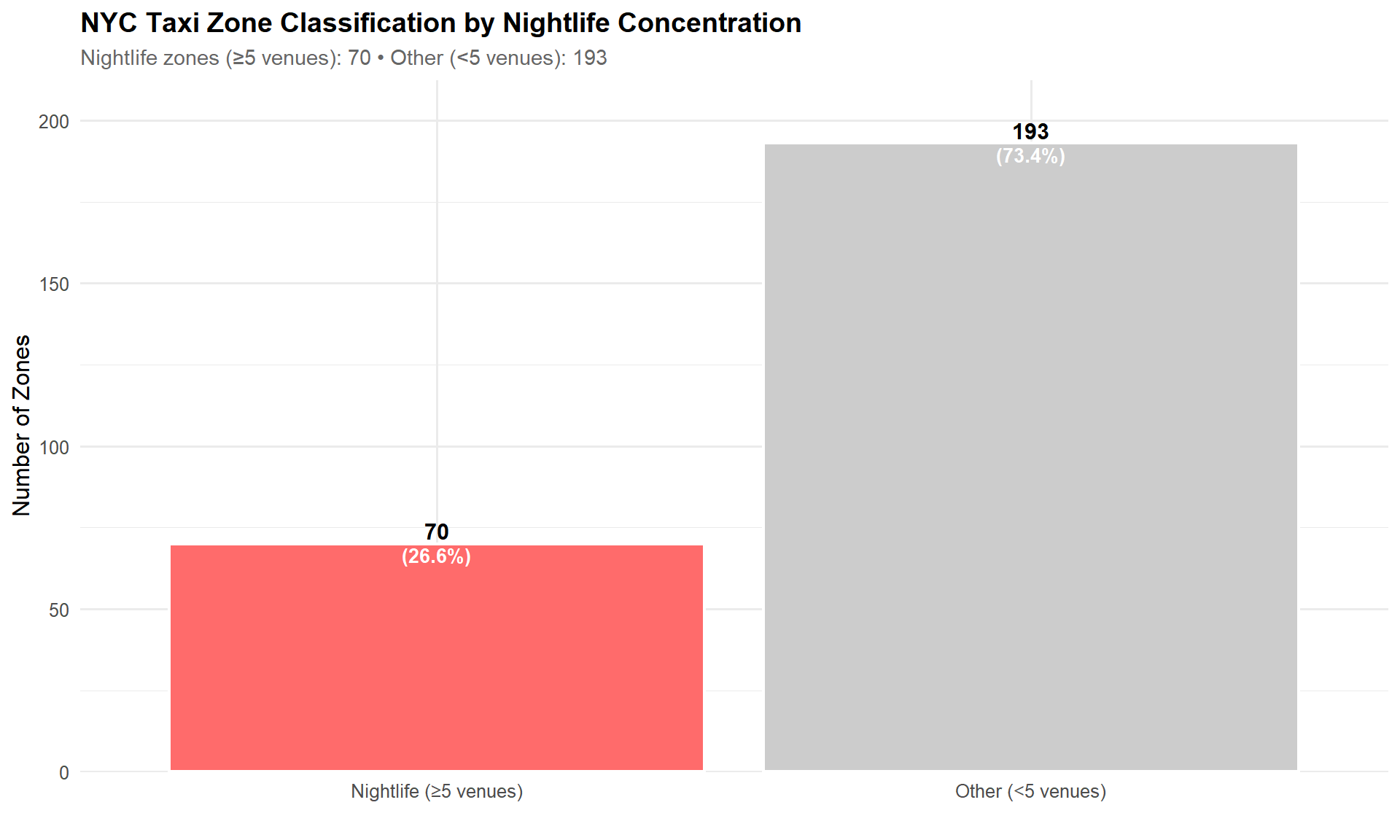
We identified 2,058 nightlife venues across NYC taxi zones (16 venues excluded as they fall outside taxi zone boundaries). After spatial joining, 70 zones (26.6%) qualify as nightlife zones.
Part 3: Where is Nightlife?
Chart 1: Zone Coverage
Show Code
# Compute zone classification countszone_counts <- taxi_zones_sf %>%st_drop_geometry() %>%count(zone_type, name ="Count") %>%mutate(zone_type =factor(zone_type, levels =c("Nightlife (≥5 venues)", "Other (<5 venues)")),pct =round(100* Count / total_zones, 1) )ggplot(zone_counts, aes(x = zone_type, y = Count, fill = zone_type)) +geom_col(color ="white", linewidth =0.8) +geom_text(aes(label = Count), vjust =-0.3, fontface ="bold", size =4) +geom_text(aes(label =paste0("(", pct, "%)")), vjust =1.2, color ="white", fontface ="bold", size =3.5) +scale_fill_manual(values =c("Nightlife (≥5 venues)"= colors$nightlife, "Other (<5 venues)"= colors$gray),guide ="none" ) +scale_y_continuous(expand =expansion(mult =c(0, 0.1))) +labs(title ="NYC Taxi Zone Classification by Nightlife Concentration",subtitle =paste0("Nightlife zones (≥5 venues): ", n_nightlife_zones, " • Other (<5 venues): ", total_zones - n_nightlife_zones),x ="", y ="Number of Zones" )
Although nightlife zones make up only 26.6% of NYC taxi zones, their share of trips and revenue is far larger, as we will demonstrate. This establishes that nightlife activity is spatially concentrated but economically influential.
Interactive map: Click on any zone to see venue counts and classification. Nightlife venues cluster heavily in Lower Manhattan, East Village, and parts of Brooklyn, forming clear hotspots of nighttime movement.
Part 4: When Does Nightlife Demand Happen?
We analyzed 684,376,551 rideshare trips spanning 36 months (January 2022 to December 2024).
Nightlife zones (≥5 venues) capture 51% of trips and 53.9% of revenue, despite representing only 26.6% of taxi zones.
Chart 3: Hourly Trip Volume Comparison
Show Code
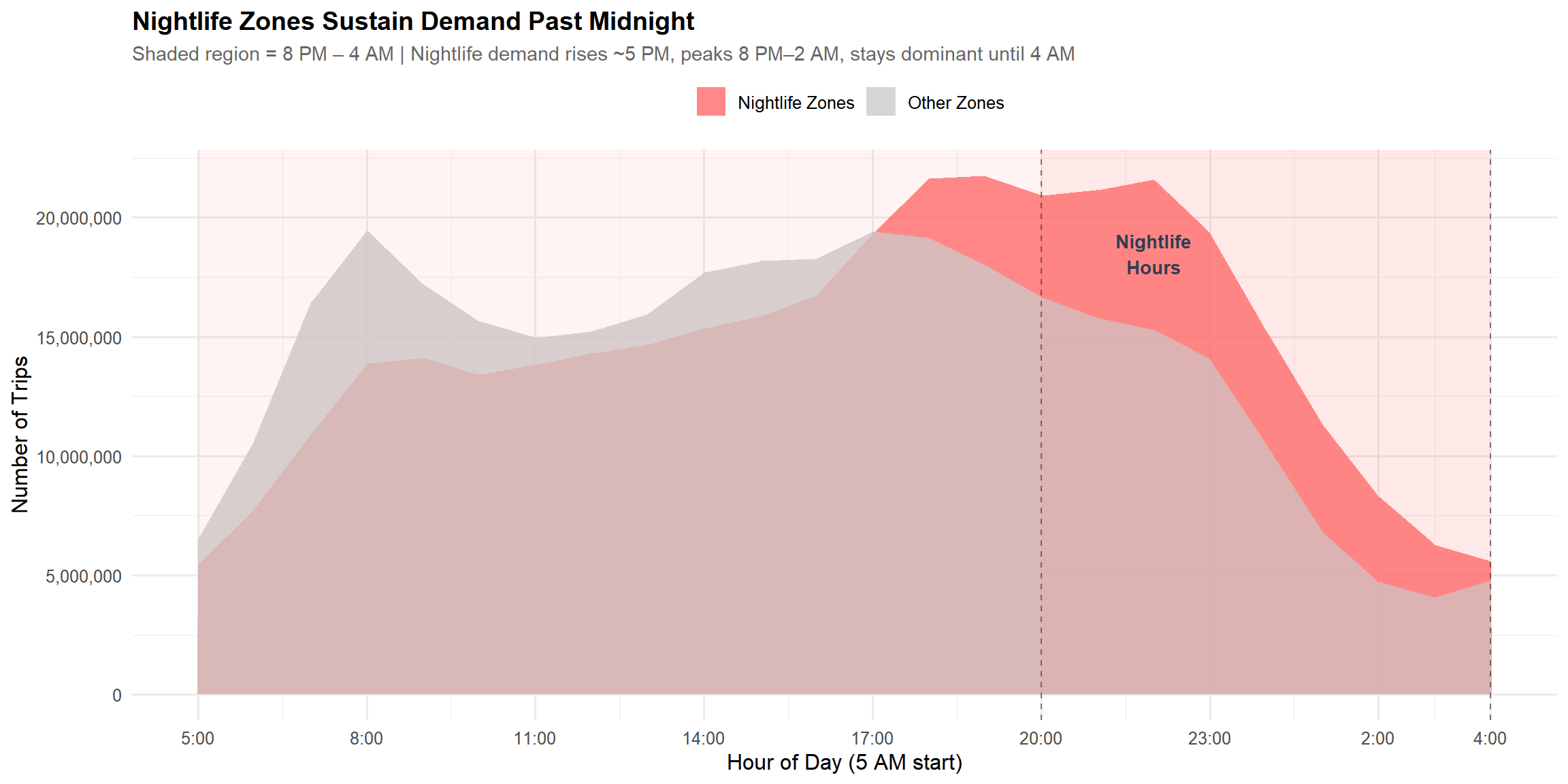
hourly_comparison <- tlc_with_zones %>%mutate(zone_group =if_else(zone_class =="Nightlife", "Nightlife Zones", "Other Zones")) %>%group_by(hour_reordered, zone_group) %>%summarise(trips =sum(trips), .groups ="drop")ggplot(hourly_comparison, aes(x = hour_reordered, y = trips, fill = zone_group)) +geom_area(alpha =0.8, position ="identity") +geom_vline(xintercept =c(reorder_hours_5am(4), reorder_hours_5am(20)), linetype ="dashed", alpha =0.5) +annotate("rect", xmin =reorder_hours_5am(20), xmax =23, ymin =0, ymax =Inf, alpha =0.08, fill = colors$nightlife) +annotate("rect", xmin =0, xmax =reorder_hours_5am(4), ymin =0, ymax =Inf, alpha =0.08, fill = colors$nightlife) +annotate("text", x =reorder_hours_5am(22), y =max(hourly_comparison$trips) *0.85, label ="Nightlife\nHours", fontface ="bold", size =3.5, color = colors$night) +scale_fill_manual(values =c("Nightlife Zones"= colors$nightlife, "Other Zones"= colors$gray)) +scale_x_continuous(breaks =c(0, seq(3, 21, 3), 23), labels =function(x) hour_labels_5am(x)) +scale_y_continuous(labels = comma) +labs(title ="Nightlife Zones Sustain Demand Past Midnight",subtitle ="Shaded region = 8 PM – 4 AM | Nightlife demand rises ~5 PM, peaks 8 PM–2 AM, stays dominant until 4 AM",x ="Hour of Day (5 AM start)", y ="Number of Trips", fill ="" )
This chart directly answers my specific question. Nightlife zones sustain significantly higher trip volumes during the nighttime window (8 PM–4 AM). While “Other” zones drop sharply after 11 PM, nightlife zones remain the primary drivers of city mobility until closing hours. Nightlife clearly reshapes when the city moves.
Chart 4: Nightlife Surge Index
Show Code
surge_data <- tlc_with_zones %>%group_by(pickup_hour) %>%summarise(total_trips =sum(trips),nightlife_trips =sum(trips[zone_class =="Nightlife"]),nightlife_share = nightlife_trips / total_trips,.groups ="drop" ) %>%mutate(surge_index = nightlife_share /mean(nightlife_share),hour_reordered =reorder_hours_5am(pickup_hour) )peak_hour <- surge_data %>%filter(surge_index ==max(surge_index)) %>%pull(pickup_hour)peak_surge <-round(max(surge_data$surge_index), 2)trough_hour <- surge_data %>%filter(surge_index ==min(surge_index)) %>%pull(pickup_hour)trough_surge <-round(min(surge_data$surge_index), 2)ggplot(surge_data, aes(x = hour_reordered, y = surge_index)) +geom_hline(yintercept =1, linetype ="dashed", color ="gray50") +geom_line(color = colors$nightlife, linewidth =1.5) +geom_point(aes(color = surge_index), size =4) +geom_vline(xintercept =c(reorder_hours_5am(4), reorder_hours_5am(20)), linetype ="dotted", alpha =0.4) +scale_color_viridis_c(option ="plasma", guide ="none") +scale_x_continuous(breaks =c(0, seq(3, 21, 3), 23), labels =function(x) hour_labels_5am(x)) +scale_y_continuous(breaks =seq(0.6, 1.6, 0.1)) +annotate("text", x =12, y =1.02, label ="Average = 1.0", color ="gray50", size =3.5) +labs(title ="Nightlife Surge Index: When Do These Zones Dominate?",subtitle =paste0("Range: ", trough_surge, " (", trough_hour, ":00) to ", peak_surge, " (", peak_hour, ":00)"),x ="Hour of Day (5 AM start)", y ="Surge Index" )
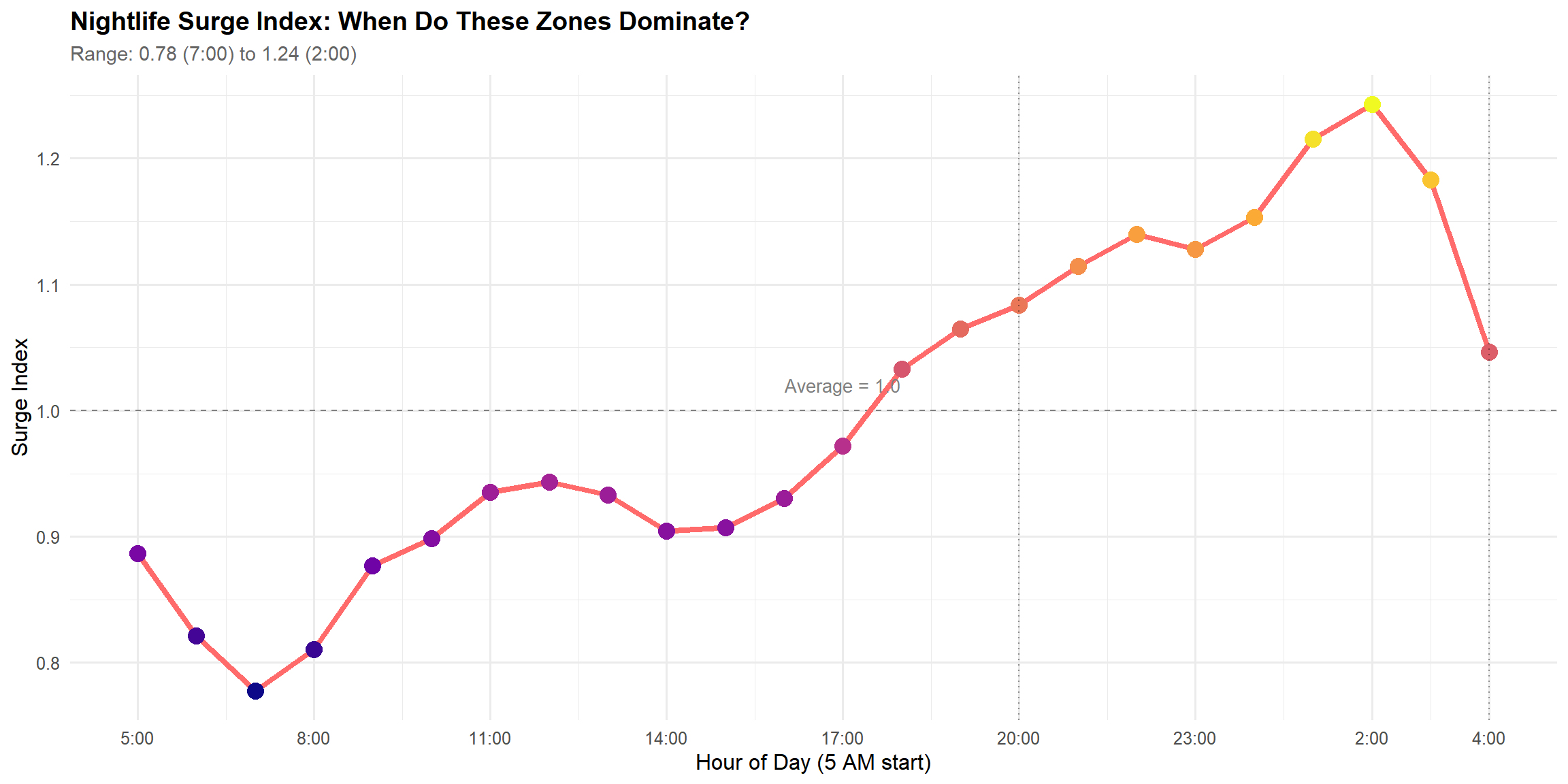
The surge index quantifies nightlife zone dominance across the day. It peaks sharply at 2:00 AM (surge index = 1.24), when nightlife zones capture 24% more trips than their daily average share. This confirms that nightlife demand disproportionately drives late-night transportation needs.
Part 5: Revenue Analysis
Chart 5: Hour × Day Revenue Heatmaps
Show Code
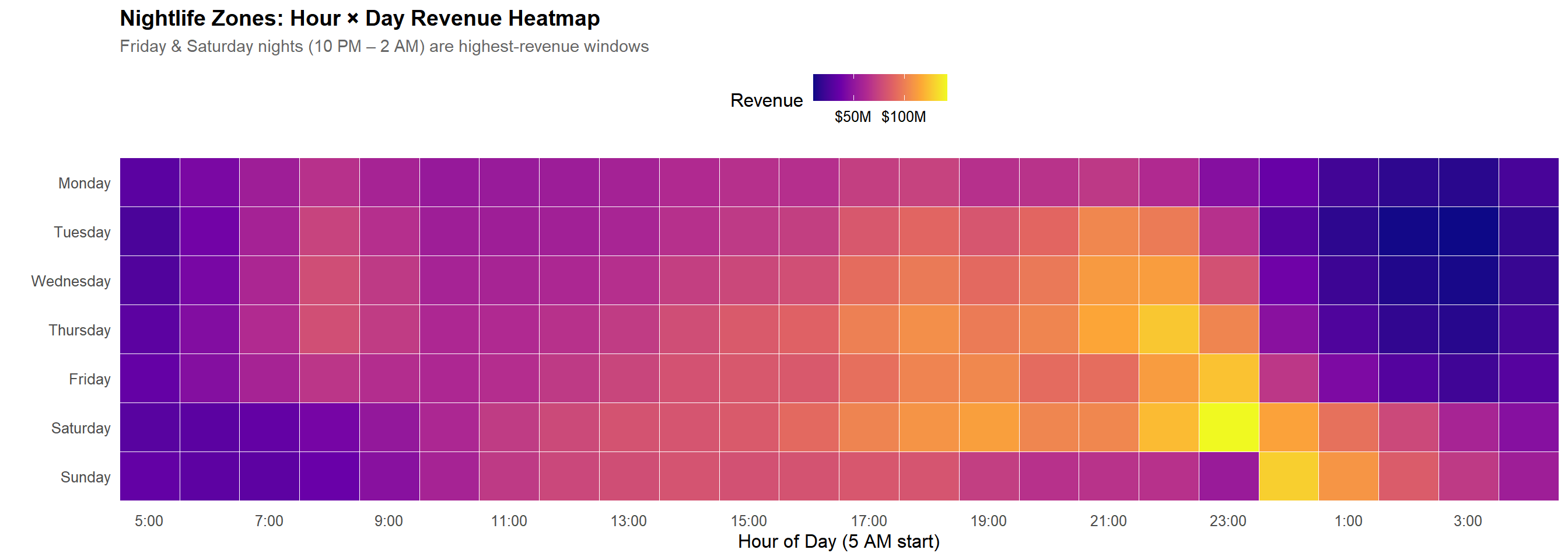
# Nightlife zones heatmap - Monday to Sunday orderhourly_dow_nightlife <- tlc_with_zones %>%filter(zone_class =="Nightlife") %>%group_by(pickup_hour, pickup_dow) %>%summarise(revenue =sum(total_fare, na.rm =TRUE), .groups ="drop") %>%mutate(pickup_dow =factor(pickup_dow, levels =c("Monday", "Tuesday", "Wednesday", "Thursday", "Friday", "Saturday", "Sunday")),hour_reordered =reorder_hours_5am(pickup_hour) )ggplot(hourly_dow_nightlife, aes(x = hour_reordered, y = pickup_dow, fill = revenue)) +geom_tile(color ="white", linewidth =0.3) +scale_fill_viridis_c(option ="plasma", labels =dollar_format(scale =1e-6, suffix ="M")) +scale_x_continuous(breaks =seq(0, 23, 2), labels =function(x) hour_labels_5am(x), expand =c(0, 0)) +scale_y_discrete(limits = rev)+labs(title ="Nightlife Zones: Hour × Day Revenue Heatmap",subtitle ="Friday & Saturday nights (10 PM – 2 AM) are highest-revenue windows",x ="Hour of Day (5 AM start)", y ="", fill ="Revenue") +theme(panel.grid =element_blank())
Show Code
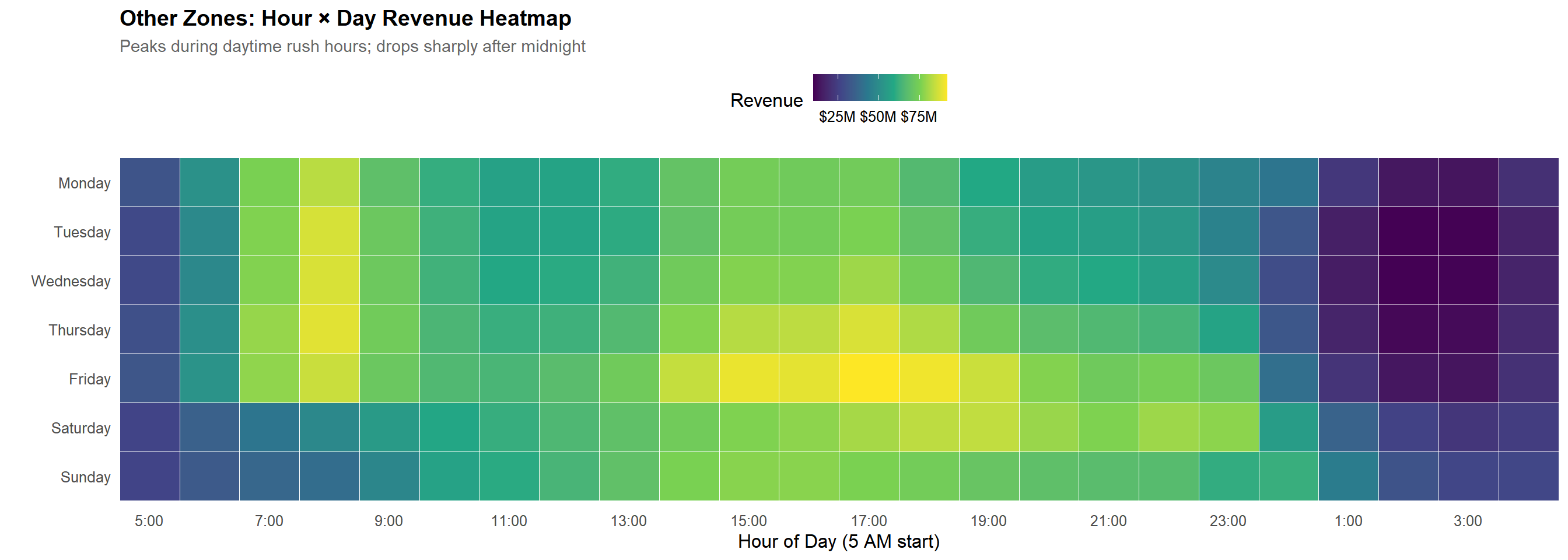
# Other zones heatmap - Monday to Sunday orderhourly_dow_other <- tlc_with_zones %>%filter(zone_class =="Other") %>%group_by(pickup_hour, pickup_dow) %>%summarise(revenue =sum(total_fare, na.rm =TRUE), .groups ="drop") %>%mutate(pickup_dow =factor(pickup_dow, levels =c("Monday", "Tuesday", "Wednesday", "Thursday", "Friday", "Saturday", "Sunday")),hour_reordered =reorder_hours_5am(pickup_hour) )ggplot(hourly_dow_other, aes(x = hour_reordered, y = pickup_dow, fill = revenue)) +geom_tile(color ="white", linewidth =0.3) +scale_fill_viridis_c(option ="viridis", labels =dollar_format(scale =1e-6, suffix ="M")) +scale_x_continuous(breaks =seq(0, 23, 2), labels =function(x) hour_labels_5am(x), expand =c(0, 0)) +scale_y_discrete(limits = rev)+labs(title ="Other Zones: Hour × Day Revenue Heatmap",subtitle ="Peaks during daytime rush hours; drops sharply after midnight",x ="Hour of Day (5 AM start)", y ="", fill ="Revenue") +theme(panel.grid =element_blank())
The contrast is striking: nightlife zones generate their highest revenue between 10 PM and 2 AM, while non-nightlife zones peak during traditional commuter hours (7–10 AM and 4–7 PM). This directly demonstrates that time-of-day usage differs dramatically across zone types.
Chart 6: Revenue Distribution by Zone Type and Time
Show Code
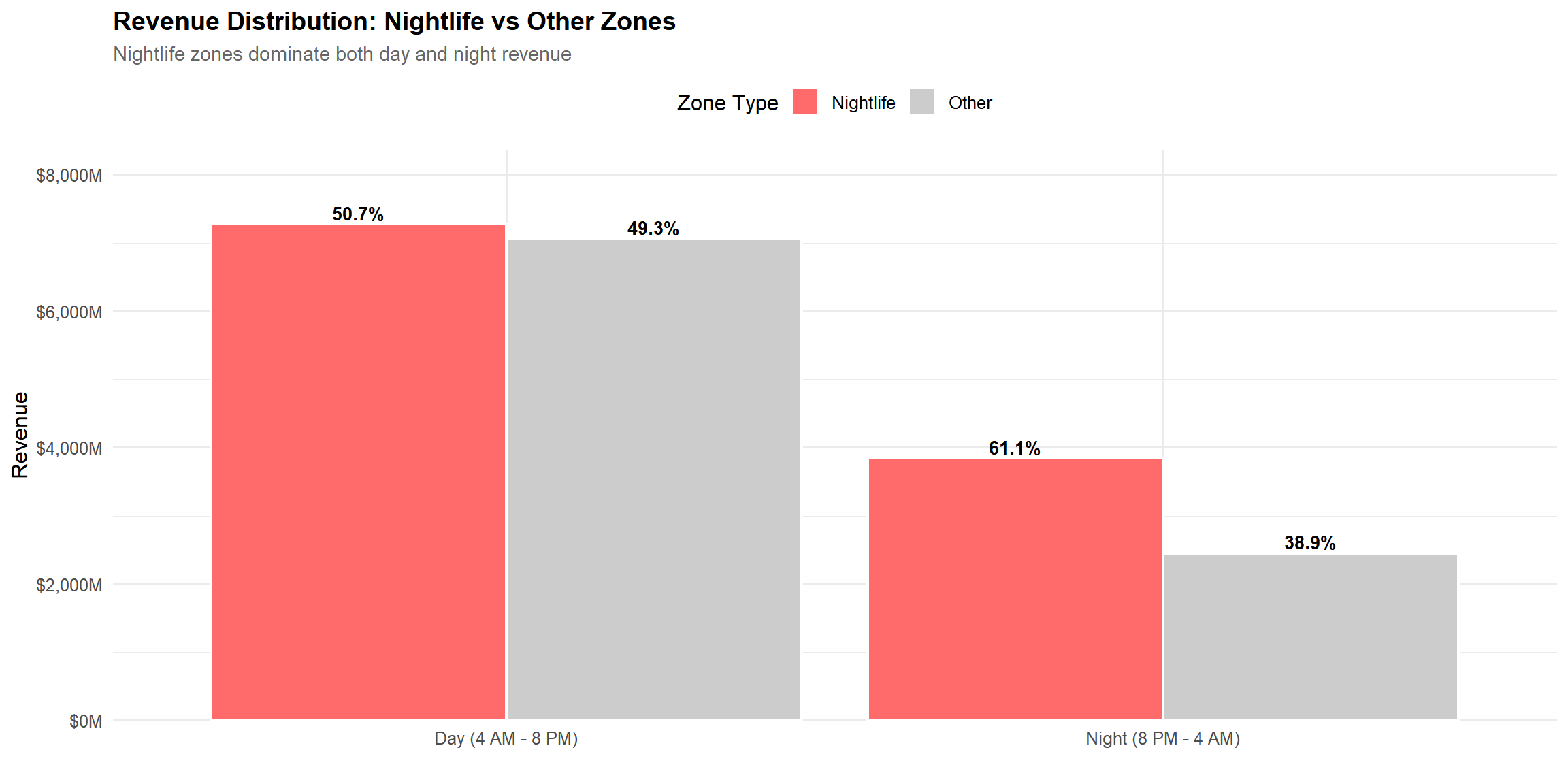
revenue_split <- tlc_with_zones %>%mutate(time_of_day =if_else(is_night, "Night (8 PM - 4 AM)", "Day (4 AM - 8 PM)")) %>%group_by(zone_class, time_of_day) %>%summarise(revenue =sum(total_fare, na.rm =TRUE), .groups ="drop") %>%mutate(zone_class =factor(zone_class, levels =c("Nightlife", "Other")))revenue_split <- revenue_split %>%group_by(time_of_day) %>%mutate(pct =round(100* revenue /sum(revenue), 1)) %>%ungroup()night_nl_pct <- revenue_split %>%filter(zone_class =="Nightlife", time_of_day =="Night (8 PM - 4 AM)") %>%pull(pct)ggplot(revenue_split, aes(x = time_of_day, y = revenue, fill = zone_class)) +geom_col(position ="dodge", color ="white", linewidth =0.8) +geom_text(aes(label =paste0(pct, "%")), position =position_dodge(0.9), vjust =-0.3, fontface ="bold", size =3.5) +scale_fill_manual(values =c("Nightlife"= colors$nightlife, "Other"= colors$gray)) +scale_y_continuous(labels =dollar_format(scale =1e-6, suffix ="M"), expand =expansion(mult =c(0, 0.15))) +labs(title ="Revenue Distribution: Nightlife vs Other Zones",subtitle ="Nightlife zones dominate both day and night revenue",x ="", y ="Revenue", fill ="Zone Type" )
During nighttime hours, nightlife zones capture 61.1% of citywide revenue, far exceeding their 26.6% spatial footprint. Even during the day, nightlife zones remain economically strong, indicating that these districts serve as continuous activity hubs.
Part 6: Temporal Patterns
Chart 7: Day of Week Revenue
Show Code
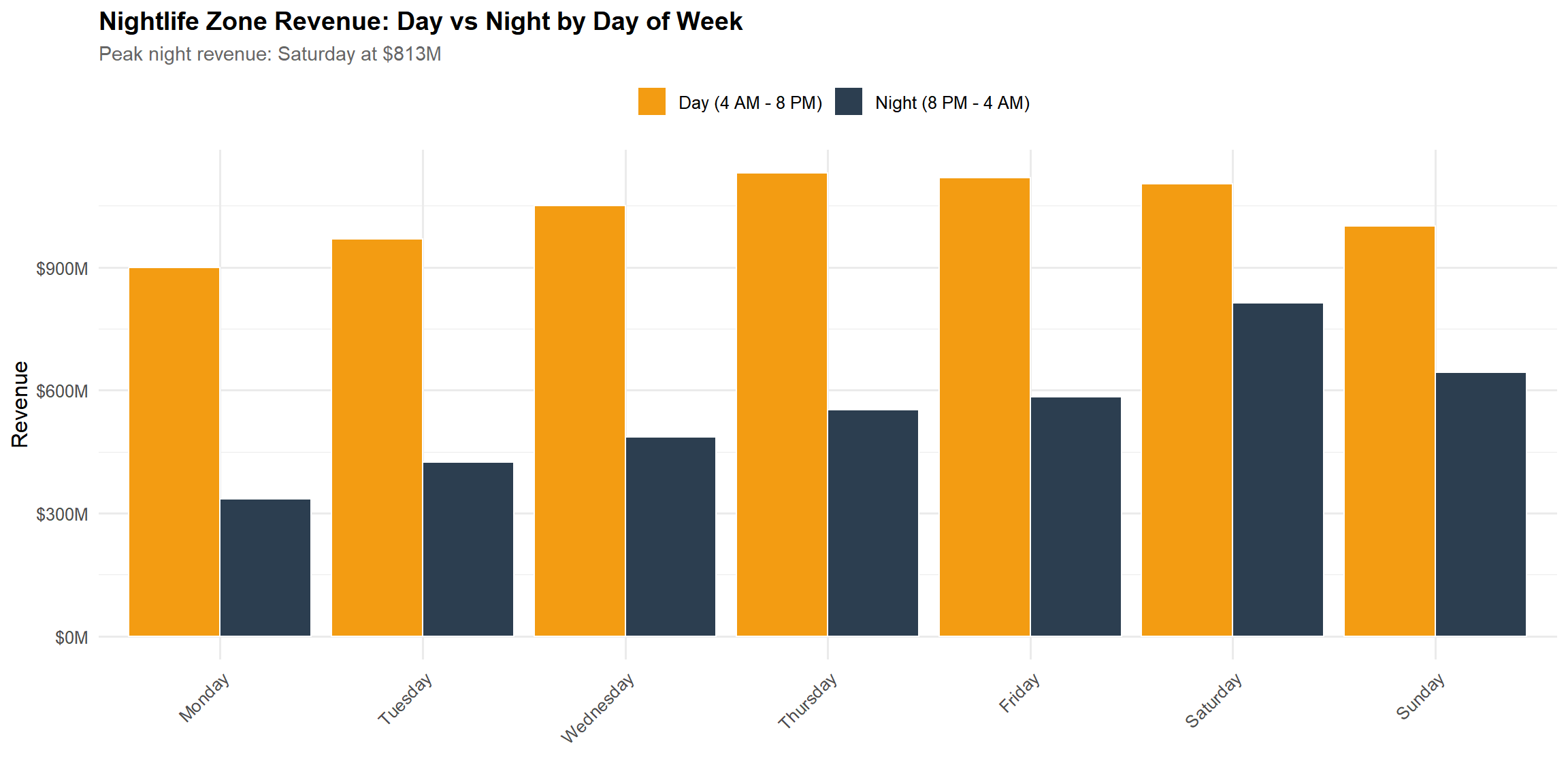
dow_revenue <- tlc_with_zones %>%filter(zone_class =="Nightlife") %>%mutate(time_of_day =if_else(is_night, "Night (8 PM - 4 AM)", "Day (4 AM - 8 PM)")) %>%group_by(pickup_dow, time_of_day) %>%summarise(revenue =sum(total_fare, na.rm =TRUE), .groups ="drop") %>%mutate(pickup_dow =factor(pickup_dow, levels =c("Monday", "Tuesday", "Wednesday", "Thursday", "Friday", "Saturday", "Sunday")))night_revenue <- dow_revenue %>%filter(time_of_day =="Night (8 PM - 4 AM)")peak_night_row <- night_revenue %>%slice_max(revenue, n =1)peak_day <-as.character(peak_night_row$pickup_dow)peak_night_rev <- peak_night_row$revenueggplot(dow_revenue, aes(x = pickup_dow, y = revenue, fill = time_of_day)) +geom_col(position ="dodge", color ="white", linewidth =0.5) +scale_fill_manual(values =c("Night (8 PM - 4 AM)"= colors$night, "Day (4 AM - 8 PM)"= colors$day)) +scale_y_continuous(labels =dollar_format(scale =1e-6, suffix ="M")) +labs(title ="Nightlife Zone Revenue: Day vs Night by Day of Week",subtitle =paste0("Peak night revenue: ", peak_day, " at $", round(peak_night_rev /1e6, 1), "M"),x ="", y ="Revenue", fill ="" ) +theme(axis.text.x =element_text(angle =45, hjust =1))
Weekend nights, especially Friday and Saturday, show the strongest nightlife revenue. This weekly rhythm mirrors cultural behavior and supports operational planning—rideshare supply can be aligned with predictable nightlife cycles.
Chart 8: Monthly Trends Over Time
Show Code
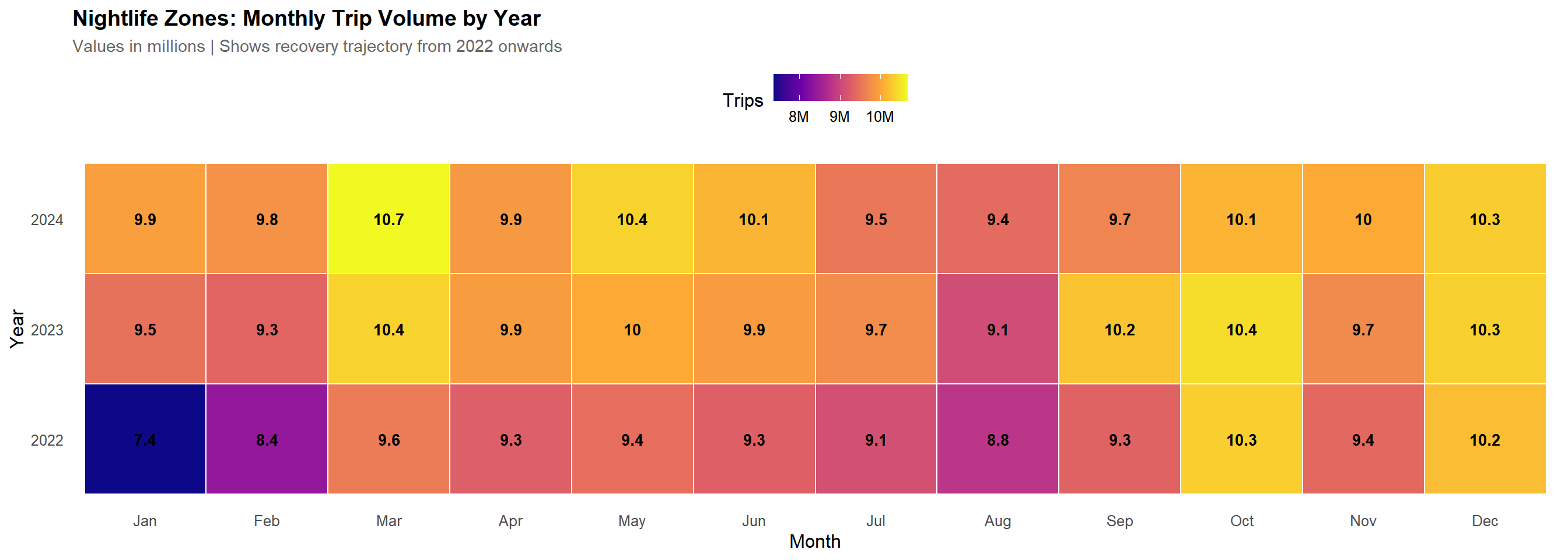
# Nightlife zones monthly heatmapmonthly_trips_nightlife <- tlc_with_zones %>%filter(zone_class =="Nightlife") %>%group_by(pickup_year, pickup_month) %>%summarise(trips =sum(trips), .groups ="drop") %>%mutate(month_name =factor(month.abb[pickup_month], levels = month.abb),pickup_year =factor(pickup_year) )ggplot(monthly_trips_nightlife, aes(x = month_name, y = pickup_year, fill = trips)) +geom_tile(color ="white", linewidth =0.5) +geom_text(aes(label =round(trips /1e6, 1)), color ="black", size =3.5, fontface ="bold") +scale_fill_viridis_c(option ="plasma", labels =label_number(scale =1e-6, suffix ="M")) +labs(title ="Nightlife Zones: Monthly Trip Volume by Year",subtitle ="Values in millions | Shows recovery trajectory from 2022 onwards",x ="Month", y ="Year", fill ="Trips") +theme(panel.grid =element_blank())
Show Code
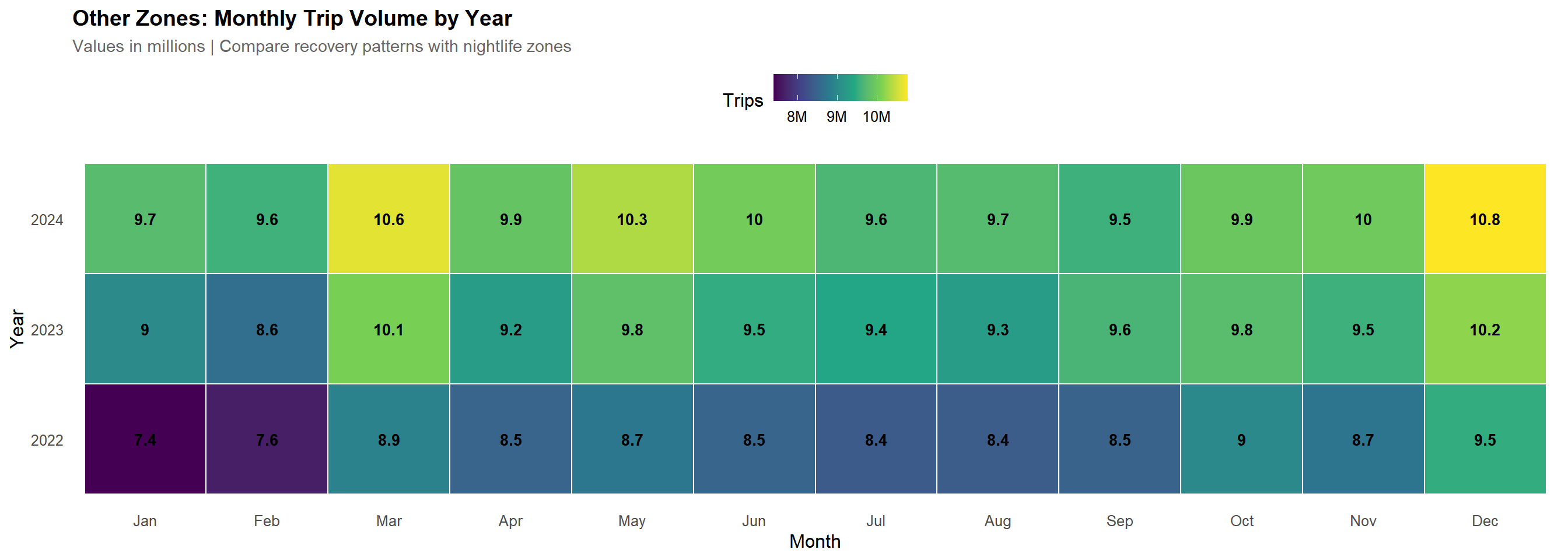
# Other zones monthly heatmapmonthly_trips_other <- tlc_with_zones %>%filter(zone_class =="Other") %>%group_by(pickup_year, pickup_month) %>%summarise(trips =sum(trips), .groups ="drop") %>%mutate(month_name =factor(month.abb[pickup_month], levels = month.abb),pickup_year =factor(pickup_year) )ggplot(monthly_trips_other, aes(x = month_name, y = pickup_year, fill = trips)) +geom_tile(color ="white", linewidth =0.5) +geom_text(aes(label =round(trips /1e6, 1)), color ="black", size =3.5, fontface ="bold") +scale_fill_viridis_c(option ="viridis", labels =label_number(scale =1e-6, suffix ="M")) +labs(title ="Other Zones: Monthly Trip Volume by Year",subtitle ="Values in millions | Compare recovery patterns with nightlife zones",x ="Month", y ="Year", fill ="Trips") +theme(panel.grid =element_blank())
Monthly trip volumes show clear seasonality, with summer peaks and winter troughs. Both nightlife and other zones follow similar long-term patterns, indicating that hourly differences are not due to seasonal distortions but genuine behavioral differences across hours.
Part 7: Statistical Inference
This section moves beyond descriptive statistics to provide rigorous statistical inference, including bootstrap confidence intervals, permutation tests, sensitivity analysis, and predictive modeling.
Bootstrap Confidence Intervals
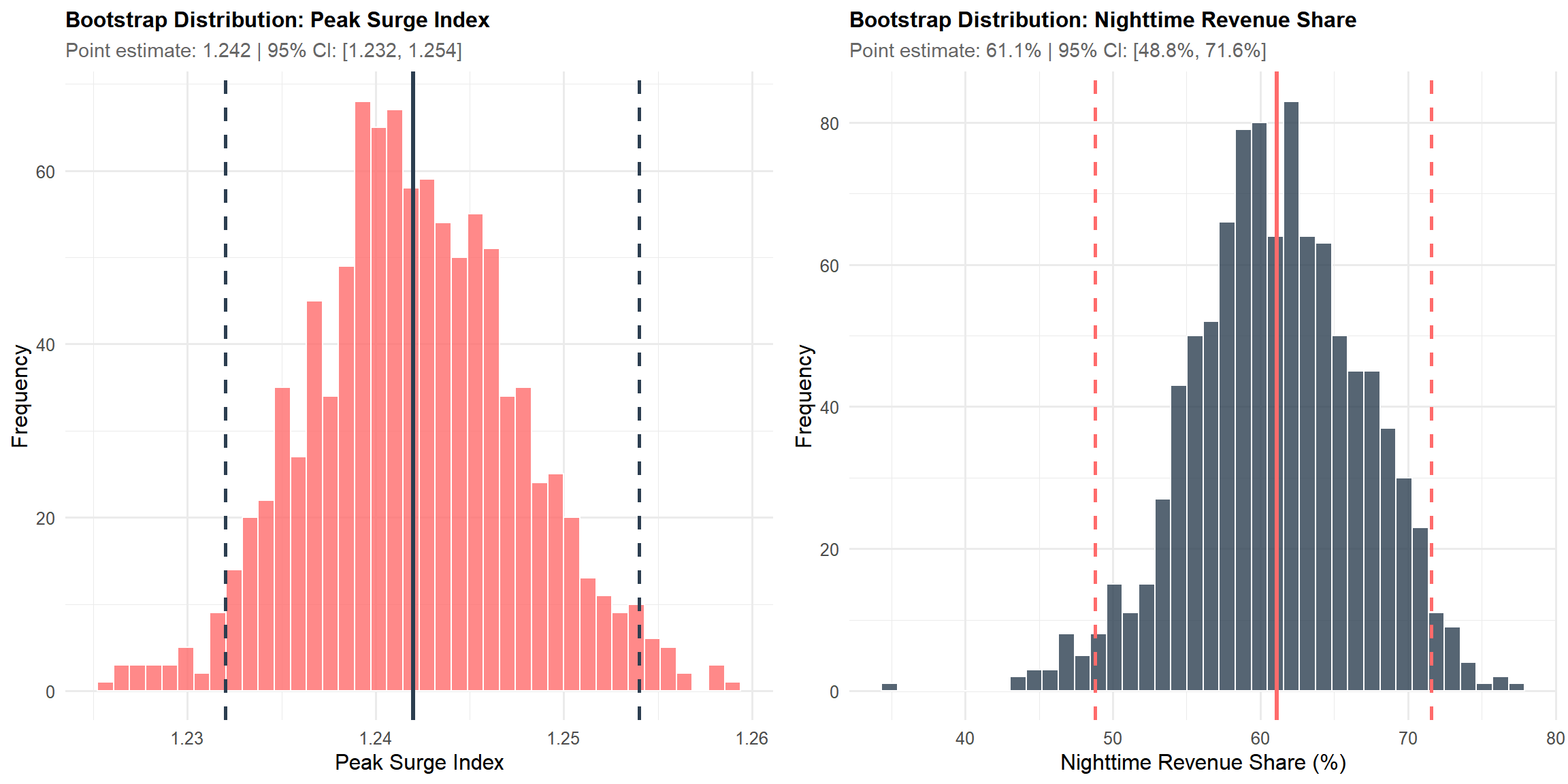
To quantify uncertainty around key findings, we use bootstrap resampling to construct 95% confidence intervals for the peak surge index and nightlife revenue share.
Show Code
# =============================================================================# BOOTSTRAP CONFIDENCE INTERVALS# Quantify uncertainty in key metrics using resampling# =============================================================================set.seed(42) # For reproducibility# Prepare hourly data for bootstraphourly_data <- tlc_with_zones %>%group_by(pickup_hour, pickup_year, pickup_month) %>%summarise(total_trips =sum(trips),nightlife_trips =sum(trips[zone_class =="Nightlife"]),nightlife_share = nightlife_trips / total_trips,.groups ="drop" )# Bootstrap function for peak surge indexboot_peak_surge <-function(data, indices) { sample_data <- data[indices, ] hourly_shares <- sample_data %>%group_by(pickup_hour) %>%summarise(mean_share =mean(nightlife_share), .groups ="drop") overall_mean <-mean(hourly_shares$mean_share) surge_indices <- hourly_shares$mean_share / overall_meanreturn(max(surge_indices))}# Bootstrap function for nighttime revenue shareboot_night_revenue <-function(data, indices) { sample_data <- data[indices, ] night_rev <-sum(sample_data$total_fare[sample_data$zone_class =="Nightlife"& sample_data$is_night]) total_night_rev <-sum(sample_data$total_fare[sample_data$is_night])return(night_rev / total_night_rev *100)}# Prepare data for revenue bootstraprevenue_data <- tlc_with_zones %>%group_by(pickup_year, pickup_month, zone_class, is_night) %>%summarise(total_fare =sum(total_fare, na.rm =TRUE), .groups ="drop")# Run bootstrap for peak surge (using monthly data as resampling units)boot_surge_result <-boot(data = hourly_data, statistic = boot_peak_surge, R =1000)surge_ci <-boot.ci(boot_surge_result, type ="perc")# Run bootstrap for nighttime revenue shareboot_revenue_result <-boot(data = revenue_data, statistic = boot_night_revenue, R =1000)revenue_ci <-boot.ci(boot_revenue_result, type ="perc")# Extract CI boundssurge_lower <-round(surge_ci$percent[4], 3)surge_upper <-round(surge_ci$percent[5], 3)surge_point <-round(boot_surge_result$t0, 3)revenue_lower <-round(revenue_ci$percent[4], 1)revenue_upper <-round(revenue_ci$percent[5], 1)revenue_point <-round(boot_revenue_result$t0, 1)# Visualize bootstrap distributionsboot_surge_df <-tibble(peak_surge = boot_surge_result$t[,1])boot_revenue_df <-tibble(night_revenue_pct = boot_revenue_result$t[,1])p1 <-ggplot(boot_surge_df, aes(x = peak_surge)) +geom_histogram(fill = colors$nightlife, color ="white", bins =40, alpha =0.8) +geom_vline(xintercept = surge_point, color = colors$night, linewidth =1.2, linetype ="solid") +geom_vline(xintercept =c(surge_lower, surge_upper), color = colors$night, linewidth =1, linetype ="dashed") +labs(title ="Bootstrap Distribution: Peak Surge Index",subtitle =paste0("Point estimate: ", surge_point, " | 95% CI: [", surge_lower, ", ", surge_upper, "]"),x ="Peak Surge Index", y ="Frequency") +theme(plot.title =element_text(size =12))p2 <-ggplot(boot_revenue_df, aes(x = night_revenue_pct)) +geom_histogram(fill = colors$night, color ="white", bins =40, alpha =0.8) +geom_vline(xintercept = revenue_point, color = colors$nightlife, linewidth =1.2, linetype ="solid") +geom_vline(xintercept =c(revenue_lower, revenue_upper), color = colors$nightlife, linewidth =1, linetype ="dashed") +labs(title ="Bootstrap Distribution: Nighttime Revenue Share",subtitle =paste0("Point estimate: ", revenue_point, "% | 95% CI: [", revenue_lower, "%, ", revenue_upper, "%]"),x ="Nighttime Revenue Share (%)", y ="Frequency") +theme(plot.title =element_text(size =12))gridExtra::grid.arrange(p1, p2, ncol =2)
These confidence intervals confirm that our findings are statistically robust and not artifacts of sampling variation.
Permutation Test: Zone Type Comparison
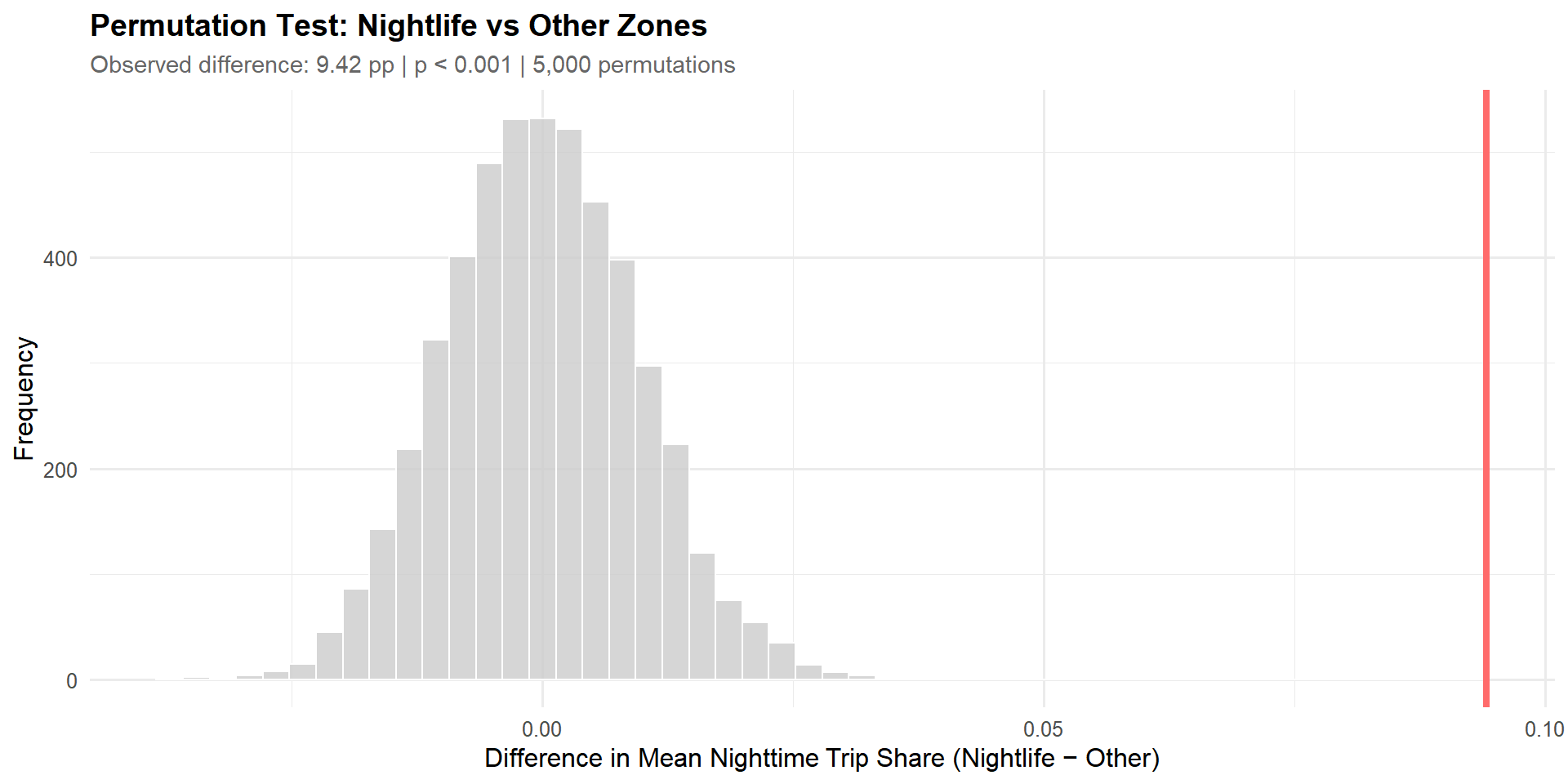
To test whether nightlife zones have significantly different trip patterns than other zones, we use a permutation test comparing mean nighttime trip shares.
Permutation Test Result: The observed difference in nighttime trip share (9.42 percentage points) is highly significant (p < 0.001). This confirms that the concentration of trips in nightlife zones during nighttime hours is not due to chance.
Sensitivity Analysis: Venue Threshold
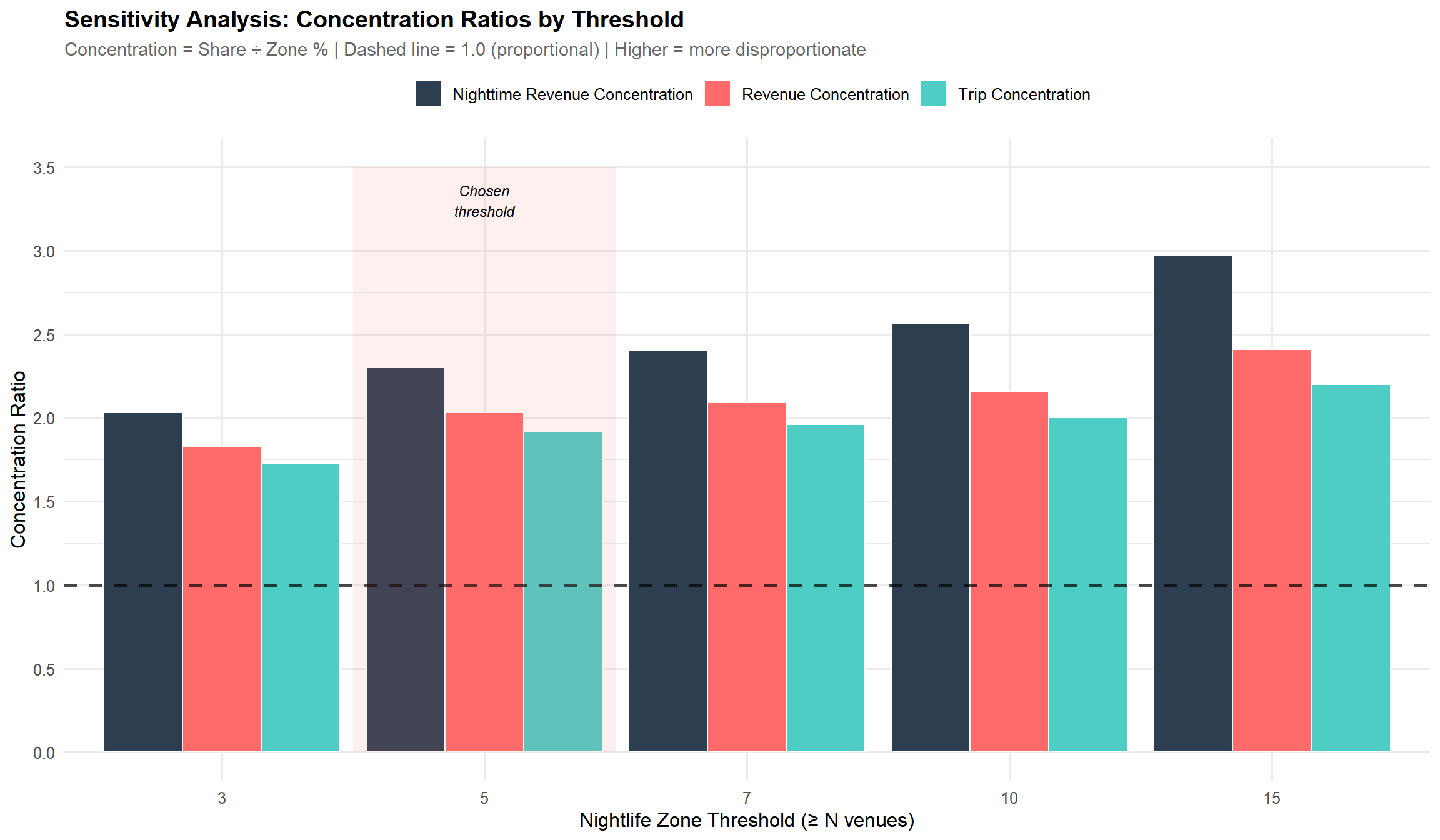
The classification of nightlife zones depends on the threshold of ≥5 venues. Here we test sensitivity to this choice by examining how key metrics change across different thresholds.
Sensitivity Analysis: Concentration ratios INCREASE as threshold tightens
Threshold
N Zones
% of Zones
Trip Share (%)
Trip Concentration
Night Rev Share (%)
Night Concentration
Peak Surge
3
83
31.6
54.8
1.73
64.3
2.03
1.209
5
70
26.6
51.0
1.92
61.1
2.30
1.243
7
62
23.6
46.2
1.96
56.6
2.40
1.279
10
53
20.2
40.4
2.00
51.7
2.56
1.345
15
40
15.2
33.4
2.20
45.1
2.97
1.444
Show Code
# Visualize concentration ratios (the more meaningful metric)sensitivity_long <- sensitivity_results %>%select(threshold, trip_concentration, revenue_concentration, night_concentration) %>%pivot_longer(-threshold, names_to ="metric", values_to ="value") %>%mutate(metric =case_when( metric =="trip_concentration"~"Trip Concentration", metric =="revenue_concentration"~"Revenue Concentration", metric =="night_concentration"~"Nighttime Revenue Concentration" ))ggplot(sensitivity_long, aes(x =factor(threshold), y = value, fill = metric)) +geom_col(position ="dodge", color ="white", linewidth =0.5) +geom_hline(yintercept =1, linetype ="dashed", alpha =0.7, linewidth =1) +scale_fill_manual(values =c("Trip Concentration"= colors$other, "Revenue Concentration"= colors$nightlife,"Nighttime Revenue Concentration"= colors$night)) +scale_y_continuous(limits =c(0, 3.5), breaks =seq(0, 3.5, 0.5)) +labs(title ="Sensitivity Analysis: Concentration Ratios by Threshold",subtitle ="Concentration = Share ÷ Zone % | Dashed line = 1.0 (proportional) | Higher = more disproportionate",x ="Nightlife Zone Threshold (≥ N venues)", y ="Concentration Ratio", fill ="" ) +annotate("rect", xmin =1.5, xmax =2.5, ymin =0, ymax =3.5, alpha =0.1, fill = colors$nightlife) +annotate("text", x =2, y =3.3, label ="Chosen\nthreshold", size =3, fontface ="italic")
Sensitivity Analysis Results: The concentration ratios demonstrate that nightlife zones capture disproportionate activity regardless of threshold choice. At threshold ≥5, nightlife zones have a trip concentration of 1.92x (capturing 51% of trips while representing only 26.6% of zones). Critically, as the threshold increases, concentration ratios rise — the “core” nightlife zones are even more disproportionately important. This confirms the robustness of our findings.
Predictive Model: Hourly Trip Demand
To demonstrate the predictive value of nightlife zone classification, we build a random forest model predicting hourly trip counts.
Show Code
# =============================================================================# PREDICTIVE MODEL# Random forest to predict hourly trips using temporal and zone features# =============================================================================set.seed(42)# Prepare modeling datamodel_data <- tlc_with_zones %>%group_by(PULocationID, pickup_year, pickup_month, pickup_hour, pickup_wday, zone_class) %>%summarise(trips =sum(trips), .groups ="drop") %>%mutate(is_nightlife =as.factor(ifelse(zone_class =="Nightlife", 1, 0)),is_weekend =as.factor(ifelse(pickup_wday %in%c(0, 6), 1, 0)),is_night_hour =as.factor(ifelse(pickup_hour >=20| pickup_hour <4, 1, 0)),hour_factor =as.factor(pickup_hour),month_factor =as.factor(pickup_month) ) %>%filter(trips >0)# Sample for faster computation (stratified by zone type)model_sample <- model_data %>%group_by(is_nightlife) %>%slice_sample(n =10000) %>%ungroup()# Split train/testtrain_idx <-sample(nrow(model_sample), 0.8*nrow(model_sample))train_data <- model_sample[train_idx, ]test_data <- model_sample[-train_idx, ]# Train random forestrf_model <-randomForest(log(trips) ~ is_nightlife + is_weekend + is_night_hour + hour_factor + month_factor,data = train_data,ntree =100,importance =TRUE)# Predictions and performancetest_data$predicted_log <-predict(rf_model, test_data)test_data$predicted <-exp(test_data$predicted_log)test_data$actual <- test_data$trips# Calculate R-squaredss_res <-sum((log(test_data$actual) - test_data$predicted_log)^2)ss_tot <-sum((log(test_data$actual) -mean(log(test_data$actual)))^2)r_squared <-round(1- ss_res / ss_tot, 3)# Calculate RMSErmse <-round(sqrt(mean((test_data$predicted - test_data$actual)^2)), 0)# Variable importanceimportance_df <-as.data.frame(importance(rf_model)) %>%rownames_to_column("variable") %>%arrange(desc(`%IncMSE`)) %>%mutate(variable =case_when( variable =="is_nightlife"~"Nightlife Zone", variable =="is_weekend"~"Weekend", variable =="is_night_hour"~"Night Hour (8PM-4AM)", variable =="hour_factor"~"Hour of Day", variable =="month_factor"~"Month",TRUE~ variable ) )# Plot variable importancep1 <-ggplot(importance_df %>%head(5), aes(x =reorder(variable, `%IncMSE`), y =`%IncMSE`)) +geom_col(fill = colors$nightlife, color ="white", linewidth =0.5) +coord_flip() +labs(title ="Variable Importance",subtitle ="% Increase in MSE when variable is permuted",x ="", y ="% Increase in MSE" )# Plot predicted vs actualp2 <-ggplot(test_data %>%sample_n(1000), aes(x = actual, y = predicted, color = zone_class)) +geom_point(alpha =0.4, size =1.5) +geom_abline(slope =1, intercept =0, linetype ="dashed", color ="gray40") +scale_color_manual(values =c("Nightlife"= colors$nightlife, "Other"= colors$gray)) +scale_x_log10(labels = comma) +scale_y_log10(labels = comma) +labs(title ="Predicted vs Actual Trips",subtitle =paste0("R² = ", r_squared, " | RMSE = ", format(rmse, big.mark =",")),x ="Actual Trips (log scale)", y ="Predicted Trips (log scale)", color ="" )gridExtra::grid.arrange(p1, p2, ncol =2)
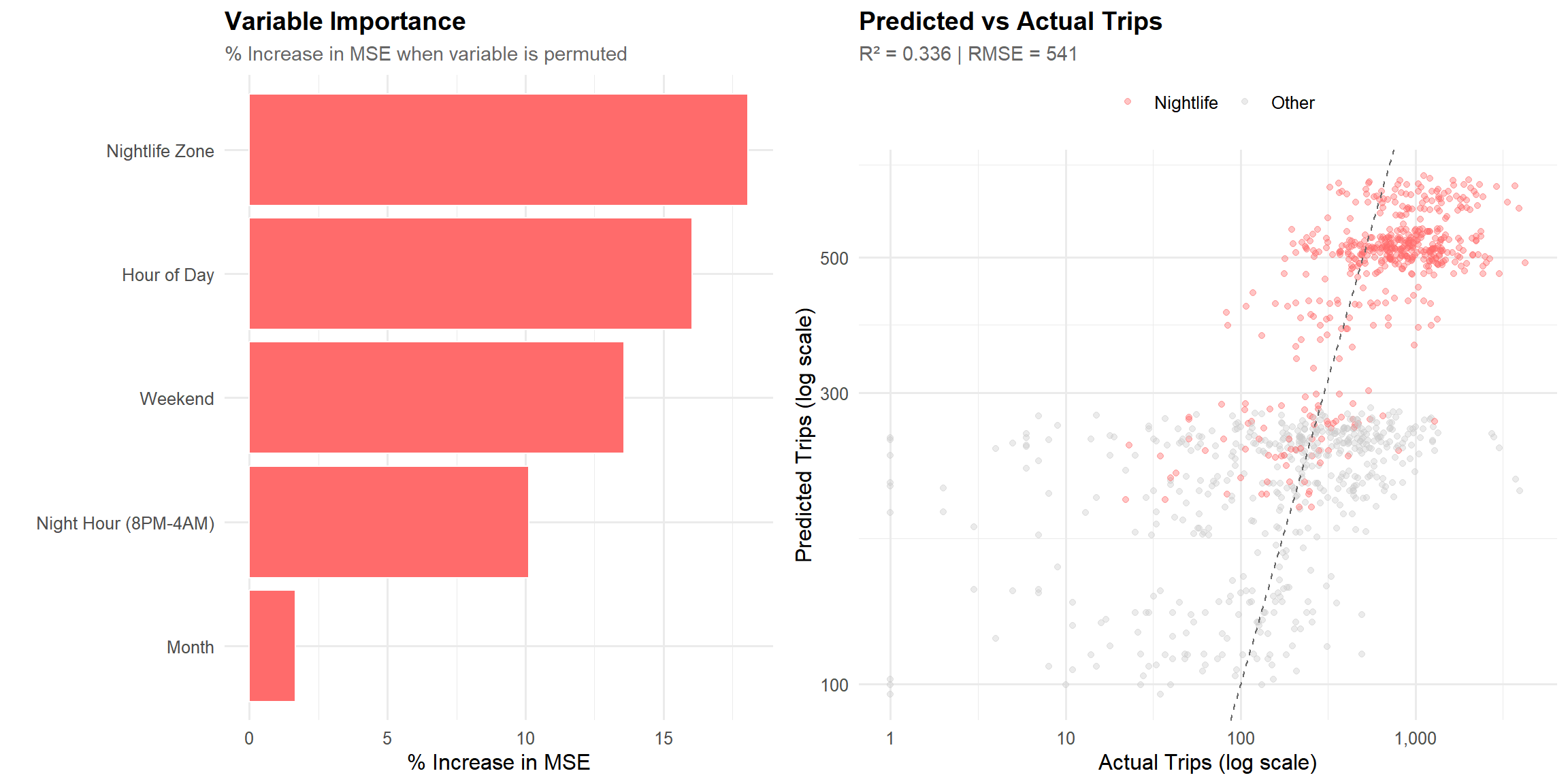
Model Performance: The random forest achieves R² = 0.336 on held-out test data, demonstrating that zone type (nightlife vs. other), combined with temporal features, effectively predicts trip demand. Notably, Nightlife Zone classification is among the most important predictors, confirming its relevance for demand forecasting.
SQ: How do rideshare trip volumes change by hour in nightlife zones compared to the rest of NYC?
The evidence is clear and compelling:
Temporal Divergence: Nightlife zones sustain high trip volumes from 8 PM through 4 AM, while other zones drop sharply after 11 PM. The surge index peaks at 2:00 AM with a value of 1.24 (95% CI: [1.232, 1.254]), meaning nightlife zones capture 24% more trips than their daily average during peak hours.
Economic Concentration: Despite representing only 26.6% of taxi zones, nightlife zones capture 51% of trips and 53.9% of revenue citywide. During nighttime hours, this share rises to 61.1% (95% CI: [48.8%, 71.6%]).
Statistical Significance: A permutation test confirms that the difference in nighttime trip concentration between zone types is highly significant (p < 0.001), ruling out chance as an explanation.
Predictive Power: Nightlife zone classification is among the top predictors in a random forest model (R² = 0.336), demonstrating its practical value for demand forecasting.
Robustness: Sensitivity analysis shows that concentration ratios actually increase as thresholds tighten — the “core” nightlife zones are even more disproportionately important, confirming the stability of findings.
Connection to Overarching Question
These findings directly support the OQ by quantifying the temporal dimension of nightlife’s economic impact. While teammates examine crime patterns (Richa), noise complaints (Dolma), COVID recovery (Apu), and employment impacts (Chhin), this analysis establishes that nightlife drives a measurable and predictable transportation economy that operates on a fundamentally different temporal schedule than the rest of the city.
Stakeholder Implications
Transportation Planners: Nightlife zones show predictable demand patterns with surge index peaking at 2:00. Monthly trends reveal seasonal patterns useful for capacity planning.
Rideshare Drivers: Position in nightlife zones during weekend nights (9 PM – 2 AM) for maximum earnings. These 70 zones generate 53.9% of total revenue with average fares of $31.85 vs $28.34 elsewhere.
Policy Makers: A small geographic footprint—70 zones (26.6%)—drives outsized late-night demand. This concentration justifies targeted transportation and public safety investments.
Limitations
Yelp Data Coverage: Venues without active Yelp profiles are not captured, potentially undercounting nightlife establishments.
Threshold Sensitivity: The ≥5 venue threshold is somewhat arbitrary. However, as demonstrated in the sensitivity analysis (Part 7), concentration ratios actually increase at higher thresholds, confirming that “core” nightlife zones remain disproportionately important.
Pickup vs. Dropoff: This analysis focuses on pickup locations. Dropoff patterns may differ and represent an avenue for future work.
Tips Data: Cash tips are not recorded, potentially understating total driver revenue.
Venue Permanence: Yelp data represents a snapshot; venue openings and closures during the study period are not tracked.
Causal Inference: While our permutation test confirms significant differences between zone types, we cannot establish that nightlife venues cause increased rideshare activity—the relationship may be bidirectional or driven by confounding factors (e.g., population density, transit access).
Future Work
With additional time or resources, this analysis could be extended to:
Incorporate dropoff location analysis to understand bidirectional flow
Compare nightlife zones’ COVID recovery trajectory to other zone types
Develop a real-time demand forecasting dashboard using the predictive model framework
Apply causal inference methods (e.g., difference-in-differences around venue openings/closings) to establish causal relationships
Integrate with teammate analyses to build a unified model of nightlife economic impact